"The Town That Burned Away a Plague: Yanshui's 140-Year Fireworks Ritual and Everyday Life"
In 1885, cholera swept through Yanshui. A temple procession of fireworks helped end it — and the ritual has run every Lantern Festival since. But Yanshui is worth visiting any time of year, for its old port streets, a free 1930s theater, and a bowl of oyster noodle soup that has been on the menu since 1945.
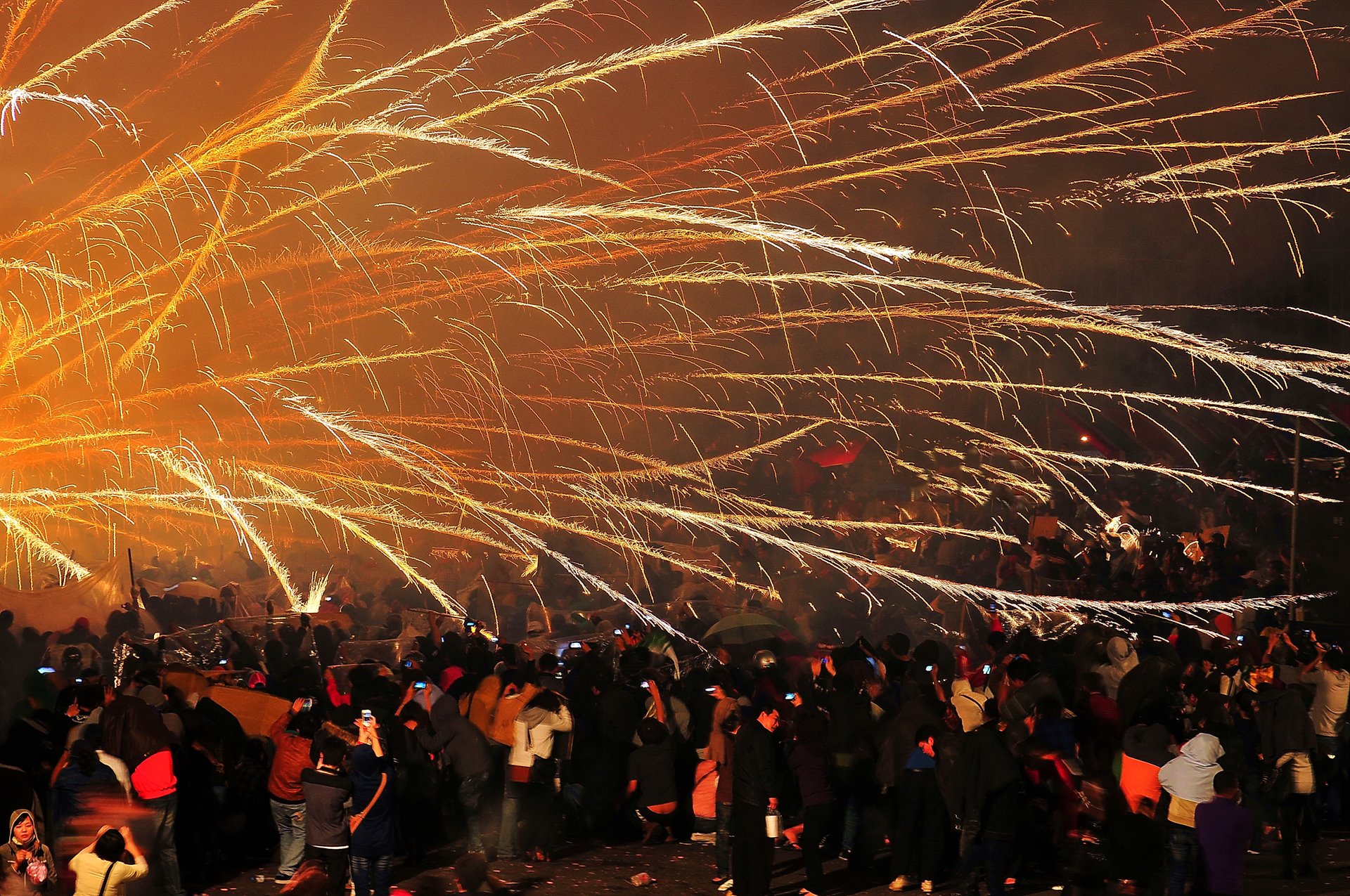
Most people who know about Yanshui know it for one thing: the annual Beehive Fireworks Festival, where thousands of rockets are fired directly into a crowd of helmeted, padded participants at close range. It's the kind of event that ends up on "world's most dangerous festivals" lists and draws a mix of thrill-seekers and photographers every Lantern Festival.
What those articles rarely cover is why it happens — or that the town is worth visiting when the fireworks are nowhere near.
Yanshui (鹽水) is a small district about 40 km north of Tainan city. During the Qing dynasty it was one of the four great trading ports in what is now Taiwan — a fact preserved in a rhyme locals still recite: 一府二鹿三艋岬四月津, which ranks Tainan (一府), Lukang (二鹿), Wanhua in Taipei (三艋岬), and Yanshui/Yuejin Harbor (四月津) in order of commercial importance. Today the harbor is long silted up and the trading ships are gone. Yanshui has the quiet, slightly untouched quality of a town that peaked two centuries ago and never quite reinvented itself — which is exactly what makes it worth the trip.
The Fireworks That Started as Medicine
In 1885, a cholera epidemic hit Yanshui hard. According to local accounts, the community appealed to Guan Di (關帝), the deity enshrined at Yanshui Wu Temple (鹽水武廟), and carried the god's palanquin through the streets in a nightlong procession — setting off fireworks the entire way to drive off the illness. The epidemic subsided.
The sulfur in the fireworks almost certainly played a real role: sulfur dioxide has genuine antiseptic properties, and a town-wide fireworks burn lasting hours would have created enough fumigation to suppress whatever was spreading. Whether you credit the deity, the chemistry, or both, the community concluded the ritual had worked and has repeated it every Lantern Festival for 140 years.
What the fireworks look like today: each "beehive" is a wooden frame densely packed with small rocket fireworks — sometimes tens of thousands per structure — angled horizontally rather than toward the sky. When ignited, the rockets shoot outward into the crowd at chest and face height. Participants wear motorcycle helmets, wrap their faces in cloth, layer themselves in thick clothing, and walk straight into it. Being hit is considered good fortune. Burns and minor injuries are common; major injuries are rare but documented.
The festival runs over two nights during the Lantern Festival — the 14th and 15th days of the first lunar month, typically in February. If you want to attend, book months ahead: accommodations in Yanshui fill up fast. Wear full motorcycle gear or rent protective equipment from vendors near the venue. No skin should be exposed.
Yanshui Wu Temple (武廟, 4 Zhongshan Road) is open 24 hours and worth stopping into any time of year. The temple is dedicated primarily to Guan Di and has the worn, lived-in quality of a place people actually use rather than visit.
Walking the Old Port Town
The best way to spend a few hours in Yanshui outside the festival is to walk the area around Qiaonan Old Street (橋南老街) and the old harbor.
Start at the Xingling Bridge at the north end of the street. The buildings along Qiaonan Old Street date from the Japanese colonial period and earlier — some facades have been maintained, others are just aging in place. There's no formal heritage district presentation here, no entrance fee, no English signage. It's just a street that hasn't been redeveloped, which in Taiwan is increasingly rare.
A short walk from the old street is Yongcheng Theater (永成戲院), a former cinema converted into a community cultural space and small exhibition hall. The building dates to the 1930s. Hours: Wednesday through Friday 1:30–5:30pm, Saturday and Sunday 9:30am–5:30pm, closed Monday and Tuesday. Free.
Also nearby: Yanshui Octagon Building (鹽水八角樓), a distinctive eight-sided structure near 4 Zhongshan Road that dates to the late Qing dynasty. It was built as a private merchant residence by a trading family at the height of Yanshui's commercial era. The exterior is the main reason to come — it's a quick detour from the temple.
The Yuejin Harbor Water Park (月津港親水公園) marks where the old trading port once sat. The harbor silted up long ago; today it's a public park along a canal, with walking paths and benches, open around the clock at no cost. It gives you a feel for the geography that made Yanshui strategically important in the first place — even if the ships have been gone for generations.
What to Eat
Dòuqiān gēng (豆簽羹) is a soup noodle dish specific to this area. The noodles are made from bean flour rather than wheat, giving them a slightly thick, silky texture. The broth usually contains oysters, milkfish (虱目魚, a staple of southern Taiwan cooking), and a starch-thickened base. Vendors have been serving this in Yanshui since at least 1945. You'll find stalls near the Wu Temple and along the streets around the old district — look for hand-painted signs and expect to pay around NT$50–70 per bowl.
Yanshui Yi Noodles (鹽水意麵) are a local variant of thin egg noodles — drier and springier than most noodles you'll encounter in Taipei, usually served with a simple broth or braised meat on top. A-Tong, A-Miao, and Yan An-qing's old shop are the names locals bring up most often, all clustered in the central market area and all operating since the mid-20th century. A bowl runs NT$40–60.
For something cold: Yin Feng Ice Parlor (銀鋒冰果室) has been on the same corner long enough that nobody seems to remember when it opened. The shaved ice with red bean and condensed milk and the fresh-pressed watermelon-lemon juice are both good. Prices vary by season; budget NT$60–100 per person.
Getting There & Practical Info
From Taipei: Take the Taiwan High Speed Rail to Tainan Station (about 1 hour 40 minutes, NT$1,080–1,350 depending on seat class), then connect by local train or bus to Xinying Station (新營站), then board bus routes 棕1, 棕3, or 棕幹線 toward Yanshui. Get off at the 分駐所 stop and walk 5–8 minutes. Total door-to-door from Taipei: around 3 hours.
From Tainan city: Drive or ride Taiwan Route 19 north — about 40 minutes. If you're already based in Tainan, renting a scooter near Tainan Station (NT$300–400 per day) is the easiest option and gives you flexibility for the return.
Getting around Yanshui: The main sites — Wu Temple, Qiaonan Old Street, Yongcheng Theater, Octagon Building, and the harbor park — are all within a 15-minute walk of each other. You don't need a taxi once you're there.
How long to spend: Half a day covers everything comfortably. Yanshui pairs well with a stop in Xinying city nearby if you want to make a full day trip from Tainan.
Language: Almost no English signage outside major facilities. Download the offline Traditional Chinese pack for Google Translate before you go — the camera function handles menus and street signs well.
Cash: Bring it. Most vendors and smaller restaurants are cash only. The local post office (郵局) has an ATM that accepts international cards.
When to visit: The Beehive Fireworks Festival is the obvious reason to come in February, but the crowds are intense and accommodation needs to be locked in months ahead. Any other time of year, Yanshui is quieter and significantly less stressful — the streets, the food, the temple, and the old architecture are all there without the logistical pressure.
Sources
- Yanshui Beehive Fireworks Festival — Wikipedia
- Yanshui/Yuejin Harbor history — local tourism site
- Yanshui 6 must-eat old restaurants — iSky Life
- 2026 Tainan Yanshui Beehive Fireworks Festival — Tainan Tourism
- First-person Beehive Fireworks account — Vocus
- Solo traveler Beehive Fireworks 2024 — Vocus
- A ritual cleansing: Taiwan's fireworks festival — Asia Media Centre