"The Lane That Kept People Alive: Herb Alley in Wanhua"
A hundred metres from Longshan Temple, Lane 224 of Xichang Street has been selling medicinal herbs since the Qing dynasty — first as the natural extension of temple divination, then as a quiet holdout against health insurance and bubble tea. What's kept it alive is a Japanese-language menu, a hand-drip bar, and a fortune-stick game.
The Lane Behind the Temple
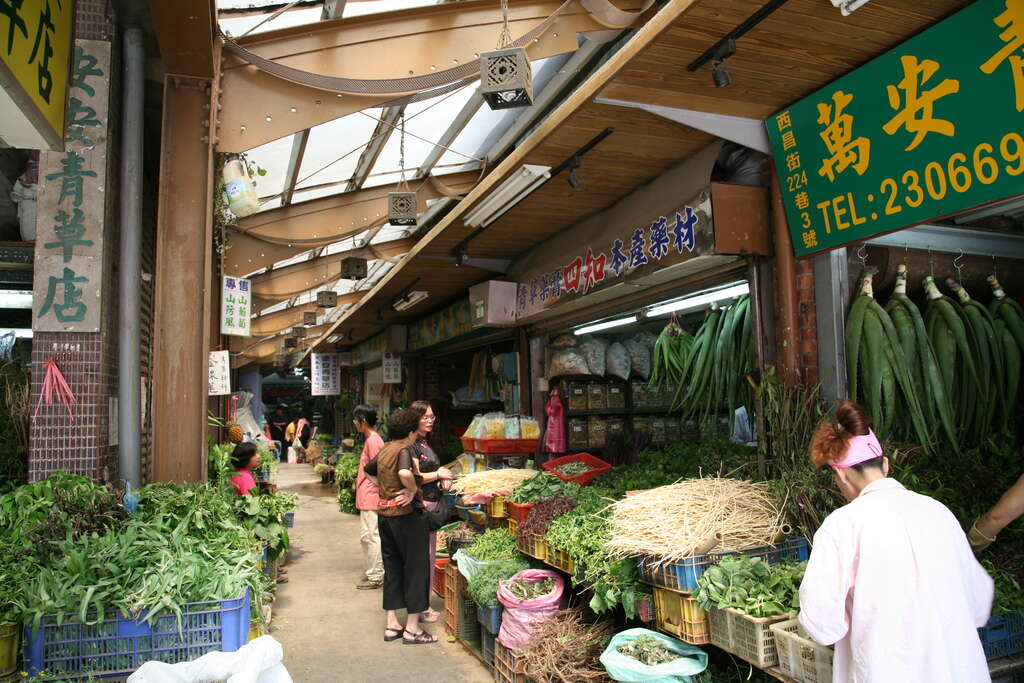
Exit Longshan Temple Station, turn left, and within three minutes you'll smell it before you see it — something green and faintly bitter, like a forest floor crossed with a pharmacy. That's Lane 224 of Xichang Street, which Taipei people have called Herb Alley (青草巷, Cing Cao Lane) for as long as anyone can reliably remember.
The lane itself is narrow enough that two people walking side by side have to be deliberate about it. On a weekday morning, bundles of dried roots hang from shop awnings, and an older woman at one counter sorts fresh grass stems into paper bags without looking up. It takes about four minutes to walk from one end to the other. Not much, on paper.
What makes it worth more than four minutes is what brought the lane into existence in the first place: the temple directly next door.
Longshan Temple has been the spiritual centre of Wanhua since Qing-dynasty Fujianese settlers built it in 1738. For most of those centuries, if you were sick, you came to the temple. You shook a tube of bamboo fortune sticks until one fell out, matched the number to a printed slip, and the slip prescribed herbs — not metaphorically, but literally: specific plants, specific quantities, specific preparations. Then you walked out of the temple gate, turned a corner, and there was the lane. The whole circuit — prayer, diagnosis, prescription, purchase — happened within a few hundred metres. The shops existed because the temple sent people to them.
That's not ancient history in the way history usually gets filed away. You can still watch it happen on a Tuesday morning.
Three Hundred Years of Staying Open
The story of how Herb Alley nearly disappeared — and how it didn't, quite — is a story about people who refused to do the sensible thing and close.
For the first two hundred-odd years, the lane operated on straightforward logic: if you got sick and couldn't afford a doctor (which described most people in colonial-era Taiwan), you came here. Japanese colonial administrators in the early twentieth century were suspicious of folk medicine but tolerated the trade. Herb foragers went into the mountains around Taipei, shop owners learned which combinations worked for which symptoms, and knowledge passed from parent to child the way most knowledge passes in family businesses — imperfectly, incompletely, but enough.
The crisis came in two waves. The first was 1995, when Taiwan introduced National Health Insurance. Suddenly a doctor's visit cost almost nothing. The rational choice was obvious, and most people made it. Foot traffic in the lane dropped sharply.
The second wave was less predictable: bubble tea. Through the late 1990s and 2000s, the same lane-end real estate that might have once housed an herb shop turned out to be worth considerably more selling sugar, tapioca, and cold milk. Several shops converted. A few closed entirely. At one point, the lane had shrunk to maybe a third of its former density.
It would be dishonest to say the lane is thriving in the way it once did. Some of the shops look tired. Peeling signage, fluorescent lights that have seen better decades, counters with empty patches where product used to be. The lane survives, but it doesn't overflow.
What kept the remainder going was a combination of stubbornness and reinvention. Most surviving shops moved toward the same basic adaptation: brew herbs in a large pot out front, sell cups for NT$20–30. Simple, immediate, and something a passing tourist could actually engage with.
Two shops pushed further than that.
德草安青 (DayOn) is the new brand launched by the family behind 德安青草店, which has been in the lane since 1898. The storefront is dark green and noticeably designed — it doesn't look like the other herb shops. What makes it genuinely useful for visitors is the menu: it comes in Chinese, Japanese, and Korean. There's also a free fortune-stick draw (藥籤, yào qiān) at the entrance — pull a stick, get a matched drink recommendation. Draw the hidden jackpot stick and the drink is free.
A few minutes' walk north on Xichang Street, 老濟安 (Healing Herbar) operates at No. 84 — outside the alley itself, but worth the detour. Founded in 1972 and now in its third generation, it runs as a hand-drip tea bar: you sit at the counter, fill out a checkbox-style health form at the door, and the owner brews something to match your condition. No Chinese required — you point, they brew. Japanese tourists make up the largest share of their foreign customers, which says something about how well the no-language-needed system actually works.
Three shops worth knowing
德草安青 (DayOn)
- Address: No. 11, Lane 224, Xichang St., Wanhua, Taipei (inside the alley)
- Hours: 09:00–19:00
- What makes it useful: Menu in Chinese, Japanese, and Korean. Free fortune-stick (藥籤) draws at the entrance — each stick matches a drink; the hidden jackpot stick gets you a free one.
- Order: San-he-yi herbal tea NT$50, herb milk tea NT$60
老濟安 Healing Herbar
- Address: No. 84, Xichang St., Wanhua, Taipei (outside the alley, ~3 min walk north)
- What makes it useful: Hand-drip bar. You fill out a checkbox health form at the door — no Chinese needed, just tick and point. Japanese tourists are their biggest foreign customer group.
- Order: Custom hand-drip experience NT$280, herbal tea NT$100 (dine-in includes a small snack)
安安青草店 (An An Herb Shop)
- Address: Near the entrance of Lane 224, Xichang St.
- What makes it useful: The closest shop to the alley entrance — easy to find and a good landmark. Sells dried herbs and traditional purification herb bundles (除穢草本包) used in Taiwanese households for generations. One of the few places you can actually buy these to take home.
What to drink
| Drink | Taste | Good for | Bitterness |
|---|---|---|---|
| Bitter herbal tea (苦茶, kǔchá) | Strong herb bitterness, clean finish | Cooling down when you feel overheated or flushed | ★★★ |
| Green herb tea (青草茶, qīngcǎo chá) | Light, grassy, slightly sweet | General refresh, settling an uneasy stomach | ★★ |
| Roselle tea (洛神花茶) | Tart and easy to drink | Cooling down after fatigue, hot-weather recovery | ★ |
| Winter melon tea (冬瓜茶) | Sweet, summery | Hydration, heat recovery | ★ |
| Herb milk tea (青薄拿鐵, qīng bò nǎ tiě) | Smooth, milky | First-timers who want something less confrontational | ★ |
If you're worried about bitterness: ask for 微甜 (wēi tián, "slightly sweet") at any shop. The milk version (拿鐵, nǎ tiě) is the lowest-commitment option.
Getting there
Getting there: MRT Bannan Line to Longshan Temple Station, exit 1. Turn left out of the exit and walk south along Xichang Street for about three minutes. The lane entrance is easy to miss — look for the bundles of dried herbs and follow your nose.
Hours: Most shops open around 08:00 and close by 22:00. Sunday sees some closures — weekday mornings are better if you want to actually talk to a shop owner.
Cost: Free to walk through. Budget NT$100–200 for tea and browsing. Nothing is priced for tourists.
Fresh versus dried: The lane carries both fresh-cut herbs (used that day, kept in water) and dried bundles (for long-term storage). Dried bundles travel well. If you're buying something to take home, ask for dried (乾燥, gān zào).
Half-day walk: Start at Herb Alley (德草安青 or 安安青草店 for tea) → 老濟安 for a slower hand-drip experience → south to Dongsan Shuei Street Market (東三水街市場), a traditional wet market that's less polished than Dongmen or Nanmen and worth seeing for it → Xinfu Town Cultural Market (新富町文化市場), a 1930s Japanese-era market hall converted into a creative space. The architecture alone justifies the detour. The whole loop takes two to three hours.
Photography: Shop owners are busy. Ask before pointing a camera at people or products — a gesture works fine.
Sources
- Bank of Culture, "Herb Alley" (文化銀行 青草巷): https://bankofculture.com/archives/4179
- Spectral Codex, "Wanhua Herb Alley": https://spectralcodex.com/wanhua-herb-alley/
- Journey.tw, Herb Lane walkthrough: https://journey.tw/herb-lane/
- Taipei Travel, attraction details: https://www.travel.taipei/en/attraction/details/1693