The Japanese Character That's Been on This Keelung Wall for 130 Years
On Yi'er Road in Keelung, there's a Victorian-style building with a Japanese katakana character carved into its gable. Most people walk past without looking up. But that 「キ」marks three Kishida brothers who crossed from Hiroshima starting in 1895 — the same year Japan took control of Taiwan — one of whom was the great-grandfather of Japan's 100th prime minister. The building has since housed a colonial clothing shop, a gold rush restaurant, and a bookshop bought with a wedding ring. The 「キ」is still there.

The Character on the Gable
Walk down Yi'er Road in Keelung's Zhongzheng District — past the red brick arcades, the shuttered storefronts, the vendors setting up for lunchtime — and at the corner of Xin'er Road, you'll see a building that stops you if you bother to look up.
The facade is Victorian: red brick with white decorative bands, arched flower windows, a tall gable that rises above the roofline. Carved into that gable, legible if you know what you're looking at, is a single Japanese katakana character: 「キ」.
Most people keep walking. The ones who do stop usually assume it's leftover signage from the Japanese colonial period (1895–1945). That's technically true — but it misses what actually sets this building apart.
That character is the first letter of the Kishida family name. It marks over a decade of history belonging to three Kishida brothers who crossed from Hiroshima starting in 1895 — the same year the Treaty of Shimonoseki transferred Taiwan from the Qing Empire to Japan. One of those brothers, Kishida Ikutaro, was the great-grandfather of Kishida Fumio, Japan's 100th prime minister. When Kishida Fumio became prime minister in 2021, Taiwanese media ran the connection as genuine news. The building had been sitting there for 126 years with nobody paying much attention to it.
A Building That Three Eras Couldn't Change
1895: Three brothers, a new colony, separate businesses
Kishida Ikutaro, a merchant from Hiroshima, crossed to Taiwan in 1895 — the same year the Treaty of Shimonoseki handed the island to Japan. He was 28. He settled near Shosento, then still just a fishing harbor, and went into the kimono and timber trade. Two years later, his younger brothers Kishida Taichiro and Kishida Kotaro followed him across. Three brothers, one new colony, three separate lines of business.
The Victorian shophouse with 「キ」carved into its gable wasn't actually built by Ikutaro. The land reclamation that created Gijucho wasn't finished until 1906, and by then Ikutaro had already been gone for seven years — he returned to Hiroshima in 1899, only four years after arriving, then moved on to Dalian in northeastern China, where he died in 1908. By the time this building went up, he wasn't in Keelung anymore, and had only two years left to live.
The brother who actually built the business into what still stands there was the second one, Taichiro. The Kishida Gofukuten and a tea house next door, the Kishida Kissaten, opened under his name, selling fine kimono and imported goods. The third brother, Kotaro, went a different direction and became one of Keelung's significant timber merchants. The Japanese colonial government was meanwhile building Gijucho into the commercial heart of Keelung, deliberately modeled on Tokyo's Ginza: red brick arcades, European classical facades, lily-shaped street lamps. The 「キ」carved into the gable is the first character of the Kishida name — precisely speaking, it's Taichiro's mark, but it stands for something closer to all three brothers' decade-plus in Keelung: one opened the door, one kept the business running, one sold timber.
By the 1930s, Gijucho was at its commercial peak: people came from across northern Taiwan to buy Western suits, pick up eyeglasses, and eat pastries from the bakeries on the same block. Taichiro eventually left Keelung too. The building stayed. The 「キ」stayed.
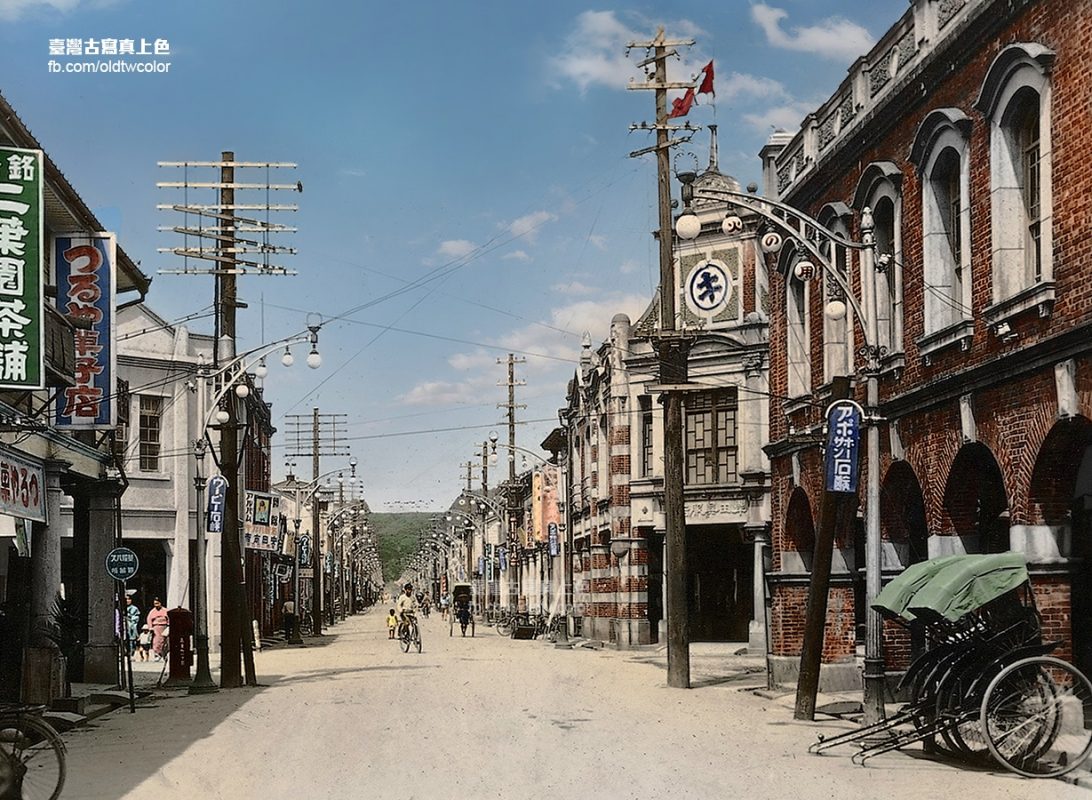
Photo credit: gjtaiwan.com
1945: Gold mine money meets a changed flag
Japan surrendered in August 1945. The Kishida family, like all Japanese nationals, was repatriated. A Taiwanese cook took over the second floor and opened the Xiao Shanghai Restaurant. The timing worked out well: the final lucrative years of the Jiufen and Jinguashi gold mines were underway in the hills above Keelung, and mine owners with money to spend needed somewhere to go. For a few years, in a building that still looked exactly as the Japanese had left it — the 「キ」unchanged on the gable — Taiwanese people sat at Taiwanese-run tables, the conqueror's family mark still hanging above the door. The Xiao Shanghai closed in 1951. The gold rush was winding down too.
1947: A bookshop bought with a wedding ring
Just months after the February 28 Incident — a brutal crackdown by the incoming Nationalist government that killed thousands of Taiwanese — a demobilized soldier named Chen Shanghui and his wife decided to open a Chinese-language bookshop in Keelung. Under Japanese rule, there had been almost no Chinese-language bookshops anywhere in Taiwan. They had no capital. Chen sold his wife's dowry jewelry and raised 100,000 old Taiwan dollars — enough for the first month's rent and an initial shipment of books. The Zili Bookshop opened on the ground floor. Chen eventually bought the building outright in 1963. The shop ran for over 70 years. Customers who first visited as children came back as grandparents.
A Street That Still Carries Its Past
The 「キ」is an entry point, not the whole story. Yi'er Road itself is the book.
When the Japanese colonial government designed Gijucho, the blueprint specified lily-shaped street lamps and connected red-brick arcade shopfronts — a deliberate transplant of Tokyo's Ginza into a Taiwanese port. Beside the Kishida store sat the Kinsetsu Gofukuten (金越吳服商), another high-end kimono merchant. Further along: watchmakers, opticians, Western pastry shops, Japanese restaurants. The finest goods available anywhere in Taiwan were concentrated on this block.
On the adjacent Yi Road (義一路), there is a spot almost no one remembers.
In 1909, a Japanese man named Ishizaka Sosaku built a small two-story wooden structure here — 24 tsubo of floor space — and named it the Ishizaka Library. It was the first library in Taiwan open to anyone, without membership fees. Dockworkers, children, anyone who could read or wanted to learn: all welcome. The courtyard had exercise equipment.
That a Japanese colonial figure built a free public space for Taiwanese people is a fact that resists simple interpretation. But the Ishizaka Library did become the ancestor of today's Keelung City Library. The building is long gone; the site is somewhere near the Taiwan Bank Keelung branch on Yi Road, with no marker. Knowing it was there changes how the block feels when you walk through.
Gijucho's merchant lineup at its peak reads like a dispatch from another century: bespoke suits, precision eyeglasses, pastries shipped from Tokyo, Japanese cuisine. In the 1930s, if you wanted the best of anything, you came here.
Stand on the same street today. The ground floor is hot pot restaurants, curry noodle stalls, fried pork chop vendors. The upper stories are still the intact Victorian facade — red brick, arched windows, unchanged. The lower floors and the upper floors are separated by a hundred years. The whole building is a time capsule with a hundred and thirty years compressed inside.
After the 「キ」: How to Spend the Afternoon
Finding the 「キ」
Stand at the corner of Yi'er Road and Xin'er Road and look up at the building's gable. Between the red brick and the white decorative band, a single katakana character has been there since 1895. Free to visit, any time.
One to two minutes away: Cattown Coffee
Walk back a short stretch along Yi'er Road and turn into Lane 2. A minute or two in is Cattown Coffee (貓町珈琲).
The space used to belong to a pig's trotter restaurant. Now it's a self-roasting coffee shop with resident cats. Keelung rains often; a window seat is a good place to wait it out.
Order the jigula burger (吉古拉堡). Jigula (吉古拉) is a pressed fish cake from Keelung's fishing neighborhoods, stuffed into an American-style bun and now considered a local specialty.
- Address: Yi'er Road, Lane 2, No. 4
- Hours: Mon, Wed–Fri 9:30–18:00; Sat–Sun 10:00–18:00; closed Tuesdays
Five minutes away: 22 meters underground
From Cattown Coffee, walk along Xin'er Road toward Zhongzheng Park. About five minutes in is the entrance to the Xin'er Air Raid Shelter (信二防空洞).
The Japanese military built it during WWII as a command post — two tunnels, 22 meters deep. When air raid sirens sounded, Gijucho's merchants and residents came running. The same people selling kimono on the street above were hiding from bombs down here. The 「キ」era and the air raid tunnel are the same era.
Free to visit; properly restored. An elevator at the far end takes you up to the Keelung Tower observation deck — the whole harbor comes into view.
- Address: Xin'er Road (near the entrance gate to Zhongzheng Park)
- Hours: 10:00–18:00, free
The afternoon route
``` Keelung Train Station (10–15 min walk) ↓ Yi'er × Xin'er Road corner — find the 「キ」 (5 min) ↓ Lane 2 → Cattown Coffee + jigula burger (30–60 min) ↓ Xin'er Road, 5 min → Air Raid Shelter + Keelung Tower (60 min) ↓ Miaokou Night Market for dinner (5–8 min walk) ```
Half a day covers the whole loop from the station. At Miaokou, order the "tenpura" (天婦羅): the name is Japanese, the food is a Taiwanese fish cake sold by the piece — the word survived colonial rule, the dish evolved into something entirely its own. Name stays, contents change. Like the 「キ」on the wall after the tenants changed.
One practical note: English signage in this part of Keelung is limited. Save the address in Chinese (基隆市中正區義二路2巷4號 for Cattown Coffee) or use Google Maps coordinates before you go.
Sources
- Keelung's Ginza: Gijucho (Yu Fu, CommonWealth Independent)
- 100,000 Old Dollars: Keelung's Zili Bookshop (Smile Taiwan)
- Xiao Shanghai Restaurant (National Cultural Memory Database)
- Kishida Fumio's great-grandfather opened a shop in Keelung (CNA)
- Keelung's century-long connection to Kishida Fumio (Keelung City Government Facebook)
- The Kishida brothers and the history of Gijucho (gjtaiwan.com)
- Kishida Ikutaro's business trail in Keelung (nicecasio blog)
- Ishizaka Library (National Cultural Memory Database)